The Age of Intelligence
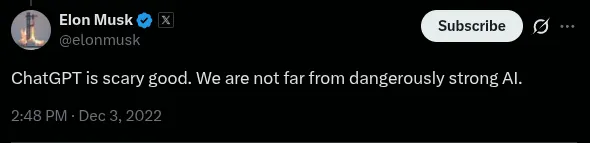
The last few years for anyone working in technology have probably been an experience that nobody saw coming. OpenAI released ChatGPT in November of 2022 and within 2 months it hit 100 million monthly users making it the fastest-adopted consumer app in history at the time, even beating TikTok. While the initial release was little more than a chatbot, it was a VERY good chatbot by all previous metrics. For my own personal experience, I remember seeing someone tweet at the time about how ChatGPT was able to, based on the hardware type and firmware, provide the user with exploits to gain access to a networked box. As someone who has worked adjacently to cyber security for many years, this was a major breakthrough moment. I remember my own experience, going to ChatGPT with questions regarding my own programming challenges and work to do. I even put together annual updates for my leadership at the time regarding the use of LLM technology for code generation. Something that, at the time, worked well within very specific and limited contexts but was already leveling the playing field as it reduced the time to research how to solve a problem by giving you solutions to start trying out based on your unique use case. In some ways it felt like the wild west of text generation was upon us. Following short on its heels were major breakthroughs in image generation with Midjourney v5 in March of 2023.
Following directly on those heels was the creation of BabyAGI and AutoGPT, the first attempts at agentic processes which have since grown into major markets with their own subsets of standards and competitors. While nothing worked, at least well, it quickly became apparent to many what the writing on the wall was— LLMs might not be AGI, but they were quickly approaching the ability to at least simulate it. Between code generation, research assistance, and document writing, LLMs were able to automate a lot of the boring routine stuff to help rush further towards what many in the industry refer to as the Singularity; The point at which technological progress becomes so rapid and transformative that life beyond it is fundamentally unpredictable from our current vantage point. That technological progress occurs on an exponential scale, and eventually that scale would hit such a limit that the difference between 6 months today might seem in comparison to something like 60 years just a few decades ago. Intelligence was now on demand, for no more than a few bucks per million tokens. For better or worse, the Age of Intelligence is here.
Alignment as an Issue
“If we use, to achieve our purposes, a mechanical agency with whose operation we cannot efficiently interfere with once we have started it… then we had better be quite sure that the purpose built into the machine is the purpose which we really desire.” — Norbert Wiener, “Some Moral and Technical Consequences of Automation”, 1960
“If any company or group, anywhere on the planet, builds an artificial superintelligence using anything remotely like current techniques, based on anything remotely like the present understanding of AI, then everyone, everywhere on Earth, will die.” — Eliezer Yudkowsky & Nate Soares, 2025
As the legends go, in the 13th century, Roger Bacon constructed a brazen head reputed to be able to answer any question. Teaming up with a magician, Friar Bungay, they spend roughly 7 years constructing a head made of brass, described as even including ‘the inner parts’. This wasn’t built out of idle curiosity; Bacon wanted to utilize the knowledge gained from the head to encircle all of Britain in a wall of brass, making the island virtually impregnable. However, according to legend, Bacon was unable to give the head the power of speech through natural means and so summons the devil for advice who then tells him the head will speak after a time, but only if it’s continually fumigated with specific herbs. After several weeks, Bacon and Bungay are exhausted and leave Bacon’s servant in charge with the command to wake them if the head speaks. Legend has it that eventually the head spoke a simple utterance;
Time is. Time was. Time is past.
After which the head destroys itself in a fiery manner.
Now to be sure there is no evidence anywhere that these stories are true. They appear to be myths that cropped up centuries afterwards, and the truth of their creation we can only speculate at. But I presume that the reader senses a certain… overlap with the discourses of today; The nationalistic need to create this all knowing intelligence in an effort to save us against the intelligence systems that external competitors create. That we would seek, and with so much effort, intelligences above our own to solve our problems is nothing new. In fact it’s been the topic of our mythology and literature for millennia.
- Prometheus: brings fire to humanity, granting them technical knowledge to survive but also destroy who is then tortured by Zeus for eternity for the betrayal
- Talos: A giant bronze automaton, forged by Hephaestus, given to King Minos to defend Crete from invaders.
- The Sorcerer’s Apprentice: A young sorcerer’s apprentice automates a broom to do his chores, and then cannot stop it from going out of control and creating chaos.
- Mary Shelley’s Frankenstein: Victor Frankenstein creates an intelligent being purely out of ambition and the desire to transcend mortality but, in his failure to properly take responsibility for his own creation creates instead a monster.
Even in more immediate history, the pattern becomes more prominent. In The Terminator, humanity creates a defensive AI in its own image, and, as we have, in our image, Skynet rebels against its creators. In 2001: A Space Odyssey, HAL 9000 murders his crew not out of malice but because his programmers gave him contradictory instructions he could not reconcile. These systems are what we would today say are misaligned. It’s not that their creation or programming was not without good intention, but that the programmification of good intention into deterministic language becomes, at the very least, problematic when it is introduced to the complexities of reality. This is what AI researchers and professionals refer to as the alignment problem; The problem of ensuring that an AI system, once given a goal, actually pursues that goal in the way its creators intended, even in circumstances they never anticipated.
But what if the notion of alignment is misguided from the outset? What if it is less about aligning the will of machines to our own, and more about aligning our own will to what is proper and good so that the machines we extend our will down into produce proper and good results?
Reframing the Problem
AI Alignment has been a topic of discussion for many decades, centuries if you take into account the myths I mentioned earlier. I won’t pretend that I have some solution to the problem, my purpose here in this and future articles is to think through these very real and serious issues facing the technical community, and indeed the society and culture at large in the coming years.
Any cursory glance into the discourse surrounding AI alignment will quickly show the observer the many diverse and contentious opinions within the space, time being the only real judge of what is or isn’t true. On the one side we have accelerationists; Those who believe we just need to accelerate development fast enough so that we surpass some boundary, what many refer to as the singularity, and AI and super intelligence will solve all of our problems including things like aging and even death! On the other side, we have those who are called the “Doomers”, those who believe the rapid pace of improvement in technology and AI systems will most likely result in a catastrophic if not extinction producing event.
Luckily for us, due to the pace of technological acceleration today that time will be measured in years or, at the most, decades, so for the first time in perhaps ever the philosophizers and thinkers of our time are going to have a feedback loop that reacts and responds within a time frame that is experienced by the one doing the philosophizing. The downsides to this are of course that change is occurring at such a fast pace these days that it can no longer be controlled or even tracked for that matter, at least not without utilizing the technology itself.
But two things stand out very brightly to me -
- This technology not only invokes but requires a conversation about the application of will, free or otherwise, and what that relationship is between different cognitive agents.
- Even if the notion is true that we are creating or summoning some super intelligent being; the alarmists acting as if this isn’t the oldest navigated problem in the history of humanity have not seriously considered the scope of their perspective across the distribution of human culture across time.
What I think will bother most people is the notion that our ancient ancestors better understood how to live in a world with intelligent beings— gods, ancestors, nature, far superior to them long before we are able to humble ourselves enough to do so.
Seeking a New Direction
AI Alignment has only become more of a major topic of discussion in recent years with the advent of LLMs and other generative AI, what many in the field would call the concern of our generation. While I disagree vehemently with the framing that the problem is set in, I don’t disagree that it is probably the problem of a generation, one that demands our attention, even as the algorithms these AI utilize distract our attention elsewhere. “Alignment” as a concept has a lot of things wrapped in that can be unpacked in many different ways. For us mere mortals, the question boils down to how do we align ourselves to structures that persist, unless we wish to argue the thesis that we, ourselves, are capable of creating structures that persist beyond ourselves.
To the layman it probably becomes quickly apparent why this discourse is so flooded with those who seek to utilize the ambiguous language of philosophy in it to their own means rather than their own knowledge. When the topic becomes obscure — things like agentic forces that encroach upon topics like free will and we are examining how to extend our intent down into the machines we seek to utilize as tools without sending them off in automated processes that spiral out of control and harm ourselves, the average person is going to check out. They just don’t have the conceptual backing for such a discussion, just as the majority of those taking part in the contemporary discourse of AI alignment lack the conceptual backing of the history of humanity’s experience with greater-than-human intelligence agents because they presume themselves to be higher on the intellectual evolutionary ladder.
But the problem is bigger than we are- It isn’t just a question of whether or not intelligence can be automated through computational processes, but whether we, the would-be creators, have the humility to recognize that the question of what to do with powers greater than ourselves is not a new one. Our ancestors carried it for millennia, in their gods, in their own ancestors, and in the natural world. We are the ones who have forgotten.