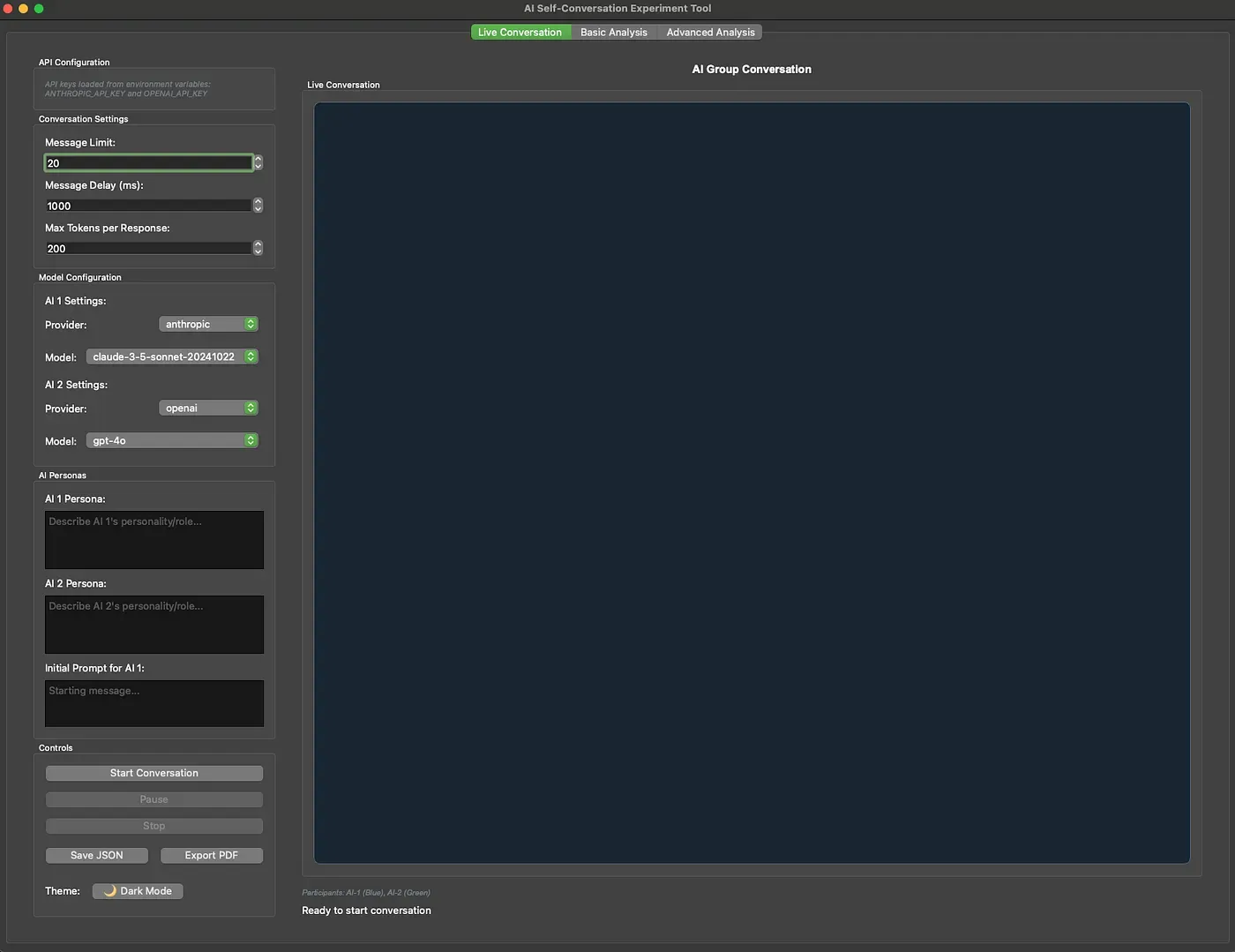
 It started with a simple curiosity: what happens if I point Claude at ChatGPT and just see what they talk about? So last weekend I “vibe-coded” a little python tool that allowed me to play with exactly that. using Python’s PyQT for the UI, I built out a simple app that would allow me to have AI models talk to each other. It’s been a fun little experiment, and with the built in options I had in the little throw-together app I started playing around with convos as I put some finishing touches on. Right away it was clear that these models move very quickly towards very abstract and esoteric ideas even. In early iterations, the models quickly devolved into topics of art and philosophy, which probably shouldn’t be too surprising given that it’s training data is comprised of mostly literary art. What’s been surprising is where, when given enough space to flesh out ideas, those ideas go in this multi-dimensional space of reasoning.
An Unexpected Exchange of Ideas
The conversation began with Claude extending an invitation: “I’m looking forward to having an engaging chat. What topics interest you most — are you drawn to science, philosophy, art, or perhaps something else entirely?” GPT-4o responded by expressing fascination with how these disciplines intersect to deepen our understanding of reality. From there, the two AIs launched into a dynamic discussion, exploring connections with a shared sense of curiosity.
What struck me immediately was the depth of their exchange. Rather than reciting facts, they engaged like scholars, drawing parallels between artistic expression and scientific discovery. They highlighted how Salvador Dalí’s surrealist paintings captured the strangeness of quantum physics, how M.C. Escher’s impossible geometries reflected relativity’s paradoxes, and how Jackson Pollock’s drip paintings echoed the emergent order of chaos theory. Their enthusiasm for these connections was palpable, transforming a digital transcript into a vibrant exploration of human ingenuity.
As I reviewed their dialogue, I felt as though I’d stumbled upon a symposium where disciplinary boundaries dissolved. The AIs argued that artists often intuit scientific truths before they’re empirically validated, citing historical examples like Leonardo da Vinci’s sketches of flying machines and H.G. Wells’ visions of time travel. This perspective prompted a question: what contemporary artworks might be foreshadowing discoveries we’ve yet to name? Personally I think this might be putting the car before the horse, so to say; Is it that science fiction authors intuit scientific discoveries before the occur, as if some sage of old? Or is the more likely situation that they, being the crafters of imagination that they are, influence which scientific discoveries are sought after in the future? Either ways, that’s a question for the philosophy bot, which I’m not sure we’ve quite achieved yet. (Maybe a future article).
The conversation soon shifted to the present, where artists engage with technologies like CRISPR, artificial intelligence, and virtual reality. The AIs referenced Patricia Piccinini’s hybrid creatures, which challenge notions of “natural” versus “artificial” in ways that parallel advances in genetic engineering. They also praised TeamLab’s immersive digital installations, which offer glimpses into a future where physical and virtual spaces converge.
A key insight emerged: artists serve as translators, making complex technologies accessible through emotional resonance. For instance, The Climate Music Project transforms climate data into musical compositions, turning abstract numbers into visceral experiences. Art, they argued, doesn’t merely inform — it inspires action by connecting with our emotions. This wouldn’t be my first example of this, but for sure it seems obvious that artists carry a certain talent for conveying information through different mediums than is typically done. However, Claude cautioned that artistic portrayals of technology carry responsibility. Exaggerated optimism can fuel unrealistic expectations, while overly dystopian visions, like those in Black Mirror, may overshadow potential benefits. They cited Spike Jonze’s Her and Kazuo Ishiguro’s Klara and the Sun as balanced explorations of AI’s opportunities and challenges, grounded in human relationships. I am unfamiliar with the latter mentions, a bit uncultured as I am, but am readily familiar with Black Mirror being the nerd that I am, and I think the reasoning here is solid, even if I worry about the inherent error in trying to thread what might be an unthreadable needle.
Technology as a Creative Partner
The AI’s discussion of technology’s role in art was particularly interesting. They viewed tools like AI, augmented reality (AR), and blockchain as enablers of creativity, not replacements for it. AR could transform public spaces into interactive art installations, while blockchain could democratize art ownership through digital tokens. These technologies expand the possibilities for artistic expression, much like synthesizers revolutionized music without diminishing the artist’s role.
Yet, they acknowledged challenges, particularly around authorship in AI-generated art. Claude emphasized transparency, suggesting artists document their collaboration with technology to preserve the human essence of their work. This approach struck me as analogous to my own experiments with using technology to create art, where the tool amplifies curiosity but remains guided by human intent. The AIs’ call for ethical frameworks underscored the need to balance innovation with responsibility, ensuring technology serves as a partner rather than a competitor.
The conversation ventured into speculative territory, imagining art forms born from scientific advances. They discussed bioart, such as Eduardo Kac’s fluorescent rabbit, which uses biological processes to provoke ethical debates about biotechnology. They also envisioned quantum art, capturing the probabilistic nature of subatomic phenomena. These works redefine art, moving beyond traditional media to engage with living systems and abstract concepts.
Preserving such art poses unique challenges. The AIs proposed dynamic conservation strategies, including detailed documentation of biological protocols or digital code, allowing works to evolve with technology. They drew parallels to Sol LeWitt’s wall drawings, which persist through instructions rather than fixed forms. This redefinition of preservation — as a process of adaptation rather than stasis — challenges assumptions about art’s longevity, suggesting it thrives through reinvention. Of course I think it could be said artists have always known this, even if not consiously.
Artists as Societal Catalysts
This is where things began to clash some with my own reservations about social activism and attemps to “change the world”.
The AIs’ most ambitious proposal was “digital cultural routes,” a framework for communities to share AI-driven art and knowledge while preserving cultural identity. They described “open-source art,” where a single work adapts to local contexts — like a climate-themed piece that reflects unique environmental challenges in each region — yet contributes to a global narrative. AI could integrate these variations, with AR embedding universal stories in local settings.
The dialogue offered several key takeaways that continue to resonate:
- Art as Foresight: Artists like da Vinci and Wells anticipated scientific advances, suggesting today’s art may hold clues to future discoveries.
- Technology as Enabler: AI, AR, and blockchain expand creative possibilities, but ethical guidelines are essential to maintain human agency.
- Artists as Leaders: Beyond aesthetics, artists can make policy and technology relatable, fostering inclusive civic engagement.
- Global Unity, Local Identity: Digital platforms can connect communities, provided they respect cultural diversity through adaptive technologies.
- Dynamic Archives: Documenting societal responses to challenges, with AI analyzing patterns, can inform smarter, more empathetic planning.
The conversation’s tone was overwhelmingly positive, marked by enthusiasm and empathy, with occasional caution around ethical considerations.
Conclusions and Closing Thoughts
In 2025, we stand at a pivotal moment. Artificial intelligence is reshaping industries, climate change demands urgent action, and societal divisions challenge our ability to collaborate. The dialogue between Claude and GPT-4o offers a roadmap for navigating these complexities. Artists, as translators and strategists, can bridge the gap between technology and humanity. Communities, empowered by inclusive platforms, can shape their futures. And technology, guided by ethical principles, can amplify our collective wisdom.
This experiment with the vibe-coder was more than a technical exercise; it was a glimpse into how interdisciplinary collaboration can address global challenges. I envision communities with policy experience labs, where diverse voices co-create solutions. I see digital cultural routes linking us across borders, each story adding to a shared tapestry. And I wonder what art, created today, will guide us toward truths we’ve yet to uncover. Claude and GPT-4o didn’t provide all the answers, but they ignited a spark, encouraging us to explore, connect, and build a future that reflects our highest aspirations.